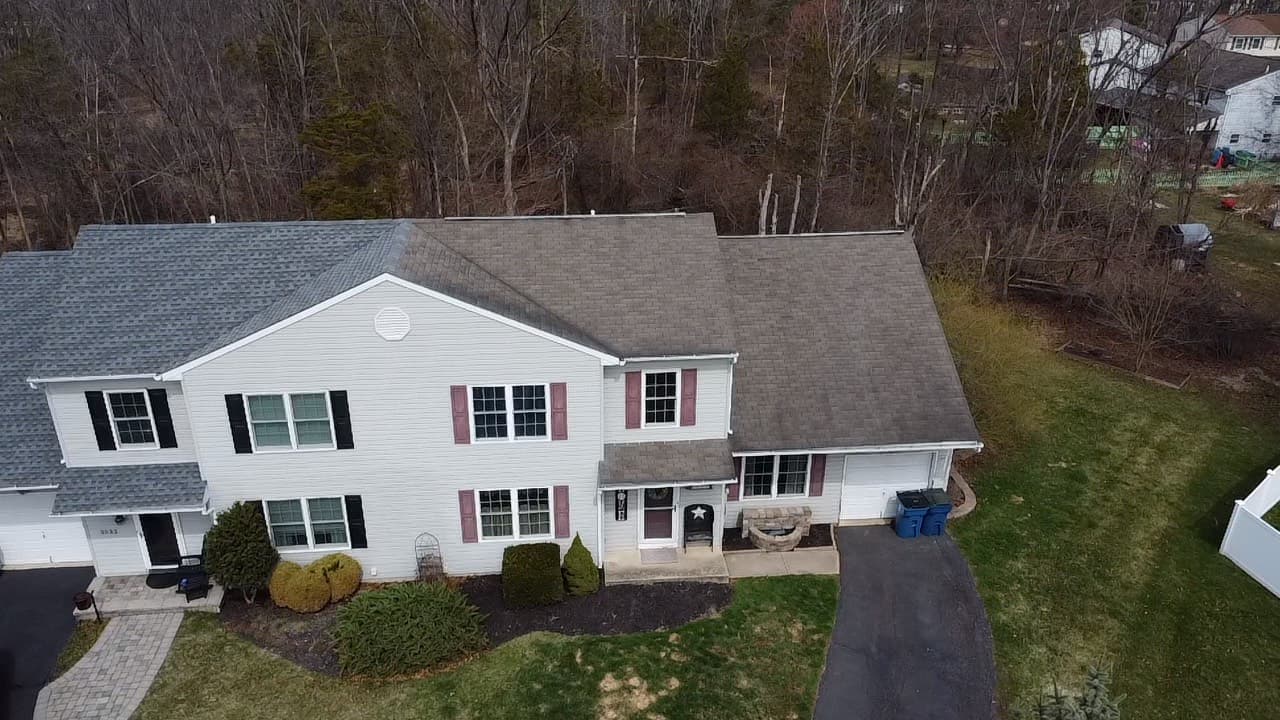
Hip Roof vs. Gable Roof: Which Is Right for Your Pennsylvania Home?
Jeff Stover
Owner of E&K Contracting with 20+ years of exterior remodeling experience in Bucks, Lehigh, and Montgomery Counties.
If you're comparing hip and gable roofs, here's the short answer: hip roofs are stronger in wind and look more uniform, while gable roofs cost less, ventilate better, and give you more attic space. In Pennsylvania, both perform well — the right choice comes down to your home's architecture, your budget, and how much you care about attic room.
After 20+ years of replacing both styles across Bucks, Lehigh, and Montgomery Counties, here's how we walk homeowners through the decision.
What is a hip roof?
A hip roof slopes downward on all four sides, with the planes meeting at a ridge (or a single peak on square homes). There are no flat, vertical ends — the roof wraps the whole house.
Where hip roofs win:
- Wind resistance. The sloped, self-bracing shape deflects wind from any direction. During the kind of straight-line wind events we see in eastern PA, hip roofs are the more forgiving design.
- Consistent eaves. Gutters and soffit run level around the entire house, which many homeowners find cleaner-looking — and it makes gutter and gutter-guard installation more uniform.
- Even weight distribution. The geometry spreads snow load across all four planes.
Where hip roofs give something up:
- Cost. More planes means more shingles, more hip and ridge cap, more labor.
- Attic space. The inward slope on all sides cuts into usable attic volume.
- More seams. Every hip is a joint, and joints are where roofs eventually leak if the installation is sloppy. Workmanship matters more on a hip roof.
What is a gable roof?
A gable roof is the classic triangle: two sloping planes meeting at a central ridge, with the triangular end walls (the gables) finished in siding or stone. It's the most common roof shape in our area, especially on the Colonials and Cape Cods that fill Doylestown and Lansdale neighborhoods.
Where gable roofs win:
- Cost. Simpler framing, fewer planes, faster installation.
- Ventilation. The open gable ends and continuous ridge make it easy to move air through the attic — a real advantage in humid Pennsylvania summers, and for preventing ice dams in winter.
- Attic space. More headroom for storage, HVAC equipment, or a future finished attic, and dormers are easier to add.
Where gable roofs give something up:
- Wind exposure. The flat gable ends act like a sail in high wind. A properly braced gable roof is fine; a poorly braced one is where storm damage starts.
- Uneven appearance. The roof reads differently from the front than from the side, which bothers some homeowners and not others.
Which one is right for a Pennsylvania home?
Our honest take: for most roof replacements, this decision was already made when your house was built. Reroofing keeps your existing structure — so the real question is usually how to get the best performance out of the style you have.
- If you have a gable roof, the priorities are proper ridge and soffit ventilation (see attic insulation and ventilation) and correctly braced gable ends. Done right, a gable roof handles PA winters without drama.
- If you have a hip roof, the priorities are quality hip and ridge detailing and clean flashing work, because those seams are the roof's weak points over a 25+ year life.
- If you're building new or adding on, choose hip for wind-exposed or open lots and a more formal look; choose gable for budget, ventilation, and attic space.
Freeze-thaw cycles are the quiet killer of roofs around here — water works into any weak seam, freezes, expands, and pries the roof apart a little more every winter. That's why we'd take a well-installed gable roof over a poorly installed hip roof every time. Style matters less than workmanship.
Not sure what shape your roof is — or what condition it's in?
If you're weighing a replacement, start with real data instead of guesswork. Our satellite roof measurement tool can pull your roof's actual geometry from your address, and our team can walk you through what your specific roof style needs to last in Pennsylvania weather.
Frequently Asked Questions
Is a hip roof more expensive than a gable roof?
Generally, yes. A hip roof has more planes, hips, and flashing details, which means more material and more labor. A gable roof's simpler framing usually makes it the more budget-friendly option to build or replace.
Which roof style handles Pennsylvania snow and wind better?
Hip roofs are self-bracing and shed wind from every direction, which helps during nor'easters and severe thunderstorms. Well-built gable roofs handle snow loads fine, but their flat gable ends catch wind and need proper bracing.
Do hip roofs have less attic space?
Usually. Because a hip roof slopes inward on all four sides, the usable attic volume is smaller than under a comparable gable roof. If attic storage or a future conversion matters to you, a gable design gives you more room.
Can I change my roof style when I replace my roof?
A standard roof replacement keeps your existing framing, so your roof style stays the same. Changing from gable to hip (or adding hips or dormers) is a structural framing project — possible, but a much larger scope than reroofing.
Roofing done right, the first time
E&K Contracting has served Bucks, Lehigh, and Montgomery County homeowners for over 20 years. Free estimates, no pressure.